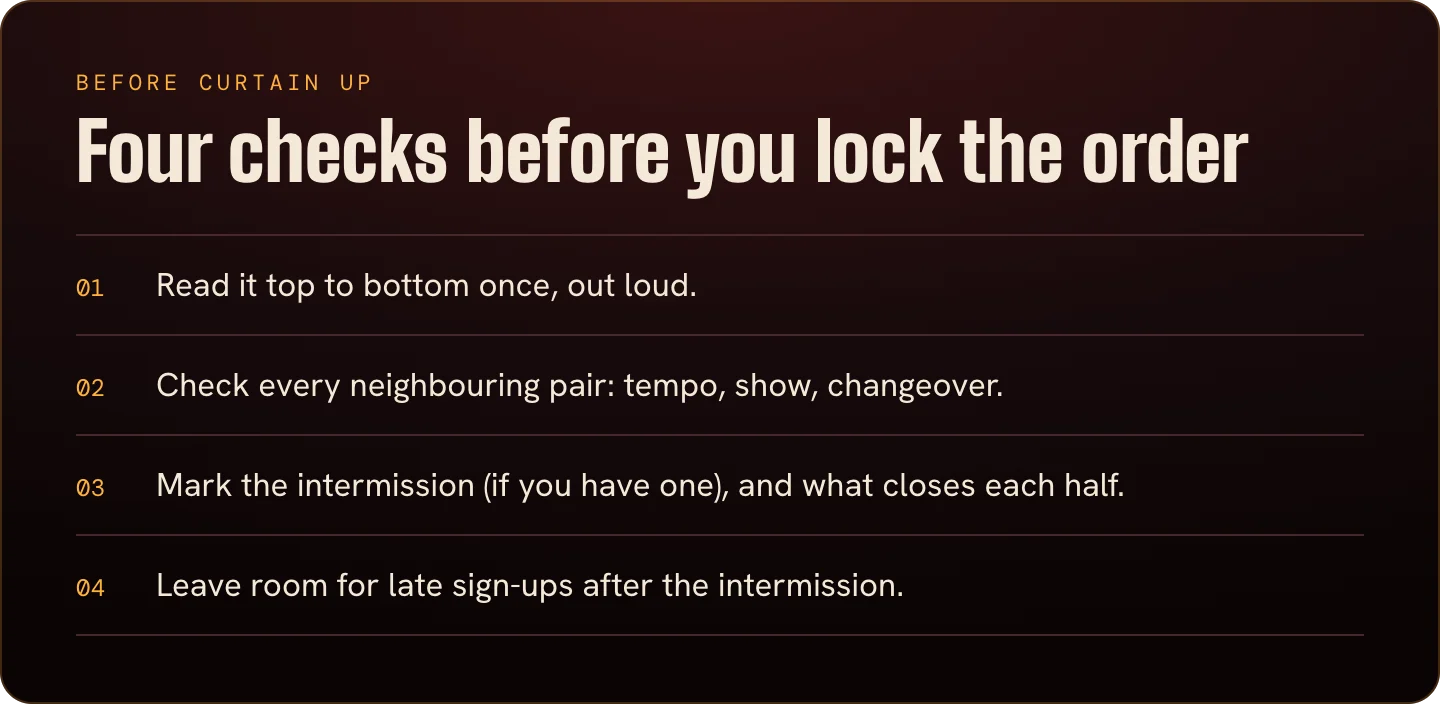
You have the acts for your showcase: twenty-two sign-ups in total, two group numbers, one person in two numbers, and a venue that wants the room clear after a couple of hours. One week out from the show, the thing that determines whether it feels like a show or working through a queue is the running order.
Event planners across most industries call this a “run of show”. Whatever you call it, getting the order right is a craft: open strong, close stronger, spread the ballads, reduce the time it takes to do the changeovers. Then those best-laid plans have to survive the show itself, which is where a paper list stops being helpful.
Here is how I build a running order – both in advance, and then in real time – from the piano at Out Night, a cabaret at North Shore Music Theatre.
Open, build, close
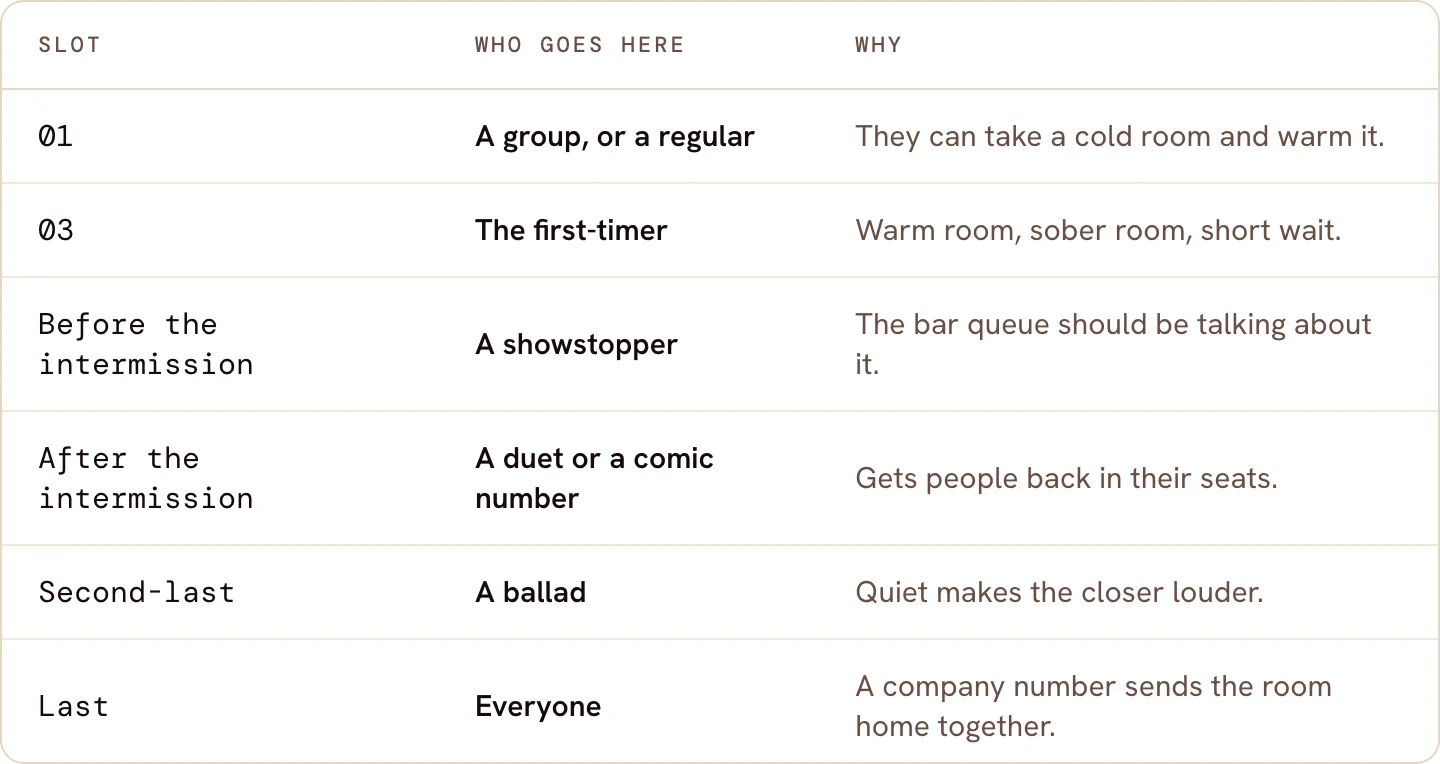
Open with your surest act, not your best one. The room is still settling and the sound is often still finding its level, so the first performer has to be able to hold attention through all of that. Band set-list advice says the same: an up-tempo, familiar number that the audience will love; nothing new or tricky.
Put a surprise second. Slot two is where the audience decides the show is worth their attention: a big voice from a young performer they didn’t expect, a comic number, a group.
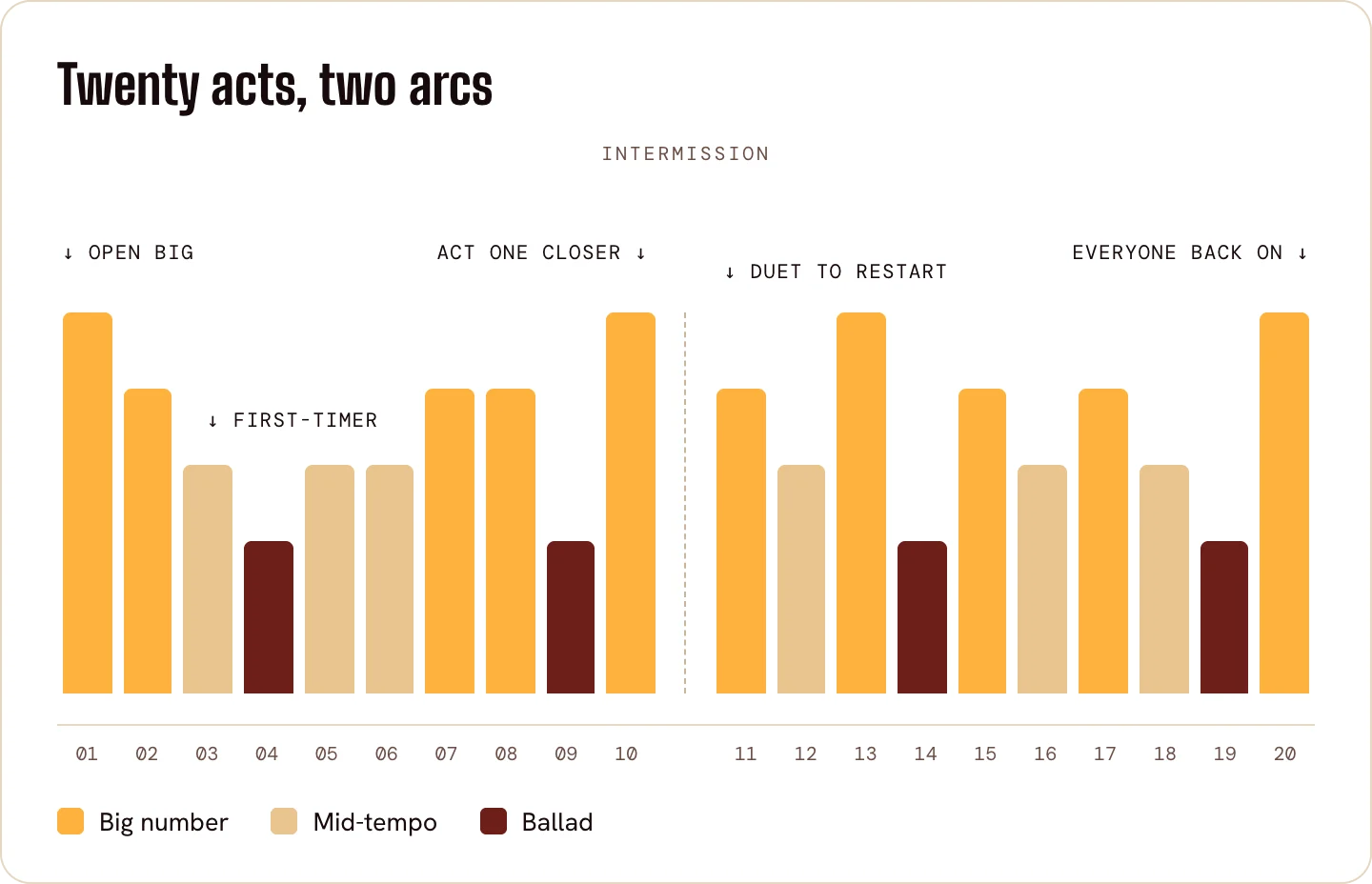
Build in runs of three or four. Fifteen acts is not linear; it is four or five short runs, each with a lift, a turn and a landing.
Close stronger than you opened. The last act is the one people talk about on the way out. Put the biggest voice or the group number there, with something quieter just before so the closer lands. Shellen Lubin, writing about cabaret for the Bistro Awards, says to end on a big uptempo number or an intimate moment. Whoever signed up last is neither.
Pacing: ballads, energy and changeovers
"A good rule of thumb is never more than 2 ballads in a row." — June Kamerling,
How to structure your musical performances, Keyboard Improv
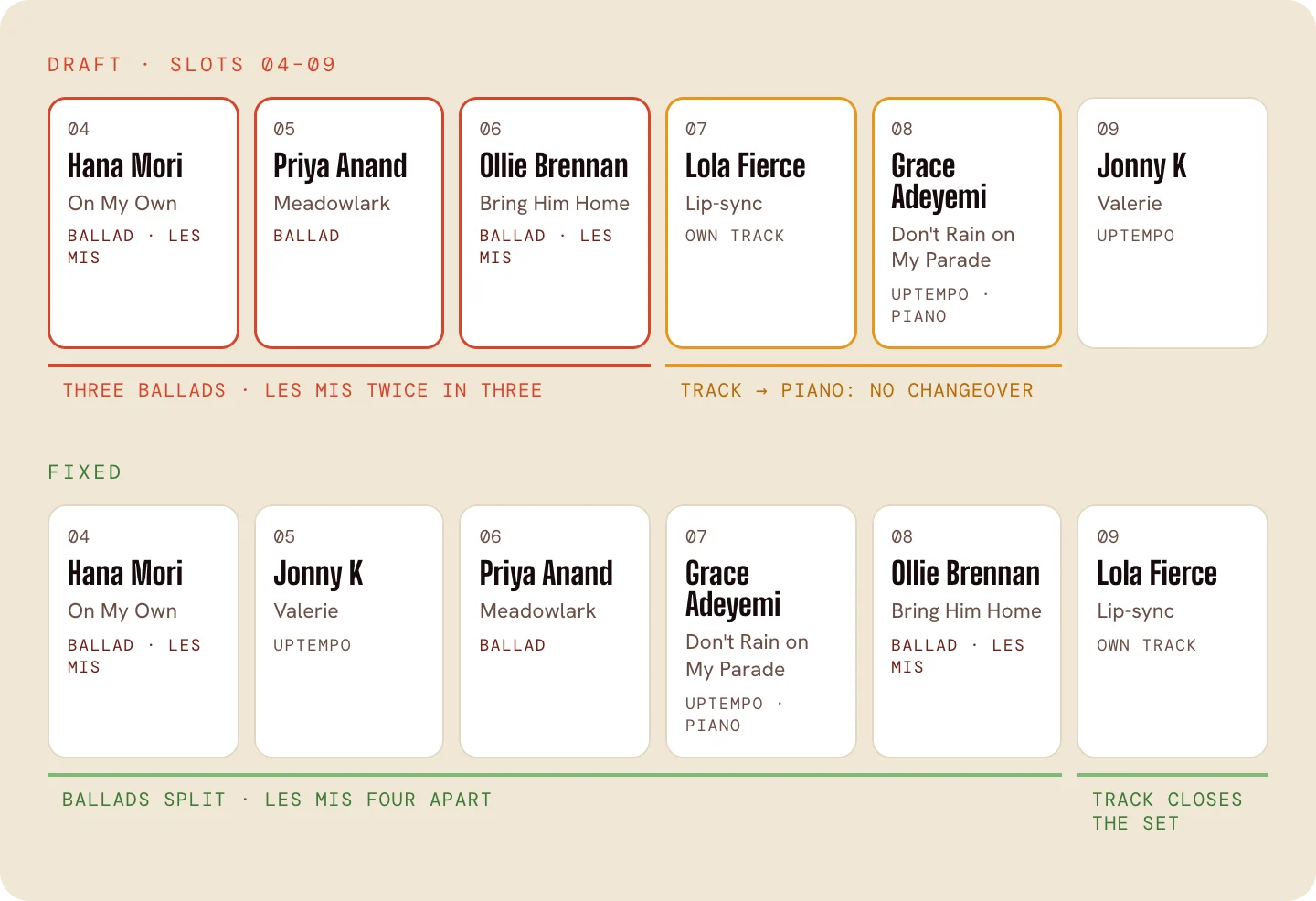
Kamerling's rule comes from solo shows, but it is the first thing to check on a bill. Mark every ballad and look at the gaps. Lubin adds that two slow songs can sit together if they differ in key, tempo and angle, and that the opposite mistake is just as real: "Two comic patter songs in a row can be just as exhausting as two sad, aching torch songs." After the most dramatic number, put something that releases the tension.
Changeovers are all about pacing too. The four or five minutes it takes for a guitarist to get setup, make sure sound levels are good, and get tuned up is a long stretch of time for the audience to be watching nothing. A technical director advising a school talent show on the ControlBooth forum put it bluntly: "You can't set that much stuff up in 5 minutes." So surround every complicated act with simple ones: a singer with a track and a mic is a thirty-second changeover, and those acts are the buffer either side of a band or a dance group. At a musical-theater open mic like the one I host, the changeover is as long it takes for the accompanist to turn a page, so the next act's music is on the piano before the current act has finished taking their bow.
Duets, groups and the people in two numbers
Place the constrained acts first, then fill the running order around them.
The person in two numbers. Keep their appearances at least four acts apart. They need time to get their breath back, potentially change, and get the feel for their second song into their head. If the second number is a duet, check the partner is paced accordingly too.
Groups. A group is a changeover problem before it is a pacing problem. The ControlBooth advice was no more than two bands, one opening the show and one opening the second half. The general version: put setup-heavy acts where the show is already stopped. Ideally top of the show or straight after the intermission.
Requests to go early. Someone always has a babysitter or a last train. Decide your policy before the show and say it once: either the running order is the running order, or early slots go to people who ask before a published cut-off. Or be more flexible and accommodating if experience has taught you otherwise.
Breaks and the second half
A fifteen-act show in which the audience remains seated wants a break. The rule of thumb is seven or eight acts, a break, seven or eight more, and with emcee introductions will take about an hour and three quarters. A rough check for your own bill: a four-minute act plus a ninety-second changeover is five and a half minutes a slot, so fifteen acts is around eighty minutes before the break and the links. If that does not fit the curfew, cut acts now rather than songs on the day.
If you’re going to do an intermission, treat act two as a second opening. The room has been to the bar and come back talking, so the first act after the break has the same job as the opener. Give slot three or four after the break, where attention sags, to an act you trust.
Breaks or stretches where nothing is happening are typically where shows lose time (and potentially audience members). Announce a maximum length for an intermission, hold to it, and have the first performer of the second act standing by before you call the room back.
Writing it down: run of show or running order
Two different documents answer to this name, so be clear which you need.
A run of show is the event planner's document: a minute-by-minute timeline for a conference, a gala or a livestream, with a row for every segment, a time against each, who is responsible, and the technical cues. Event guides also call it a run sheet or a cue sheet. A gala with speeches, a video and an auction needs one; a spreadsheet is enough.
A running order is the performer-facing list: who is on, what they are doing, in what order. It is the thing on the wall by the stage door, on the screen in the room and in every performer's head. For a showcase, a talent show or an open mic, the running order is the document that matters; the run of show is a few lines around it: doors, start, break, end.
You do not need a overly complicated running order template, or a set list template. Four columns do the job: slot number, performer, piece being performed, and maybe some notes (key, track, mic count). Add a planned length and a running total, and you can quickly find out in advance that you’re going to run twenty minutes longer than expected. Which is much better than having a venue owner watching the clock, getting irritable, and trying to hurry you out.
Then version it. Date the sheet, make sure the sound desk and the stage door have the latest one, and accept the limitations of paper: the moment someone drops out at 7:40, every copy is wrong.
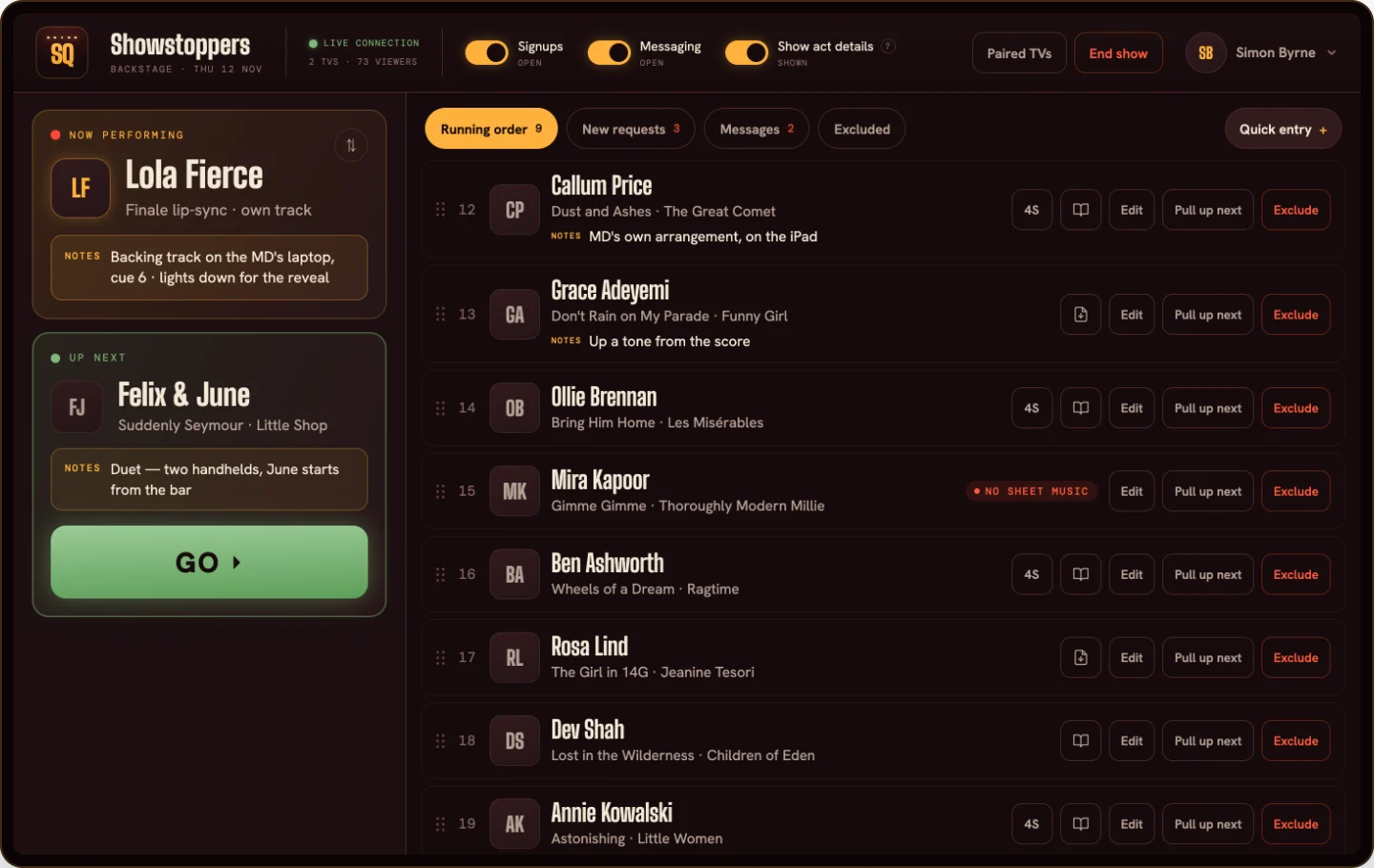
That limit is why StageQueue keeps the running order in one place. Sign-ups from the audience and performer interface (Front Row) arrive into the host’s interface (Backstage) as the list; you drag the rows into order before the show, rehearse it, and the same order appears on every phone that signed up and on the venue TV (Big Screen). Nothing to print, nothing to reprint. See how it works.
When the order changes during the show
It will. Someone does not turn up, or backs out and just wants to watch other performers. Someone turns up who did not sign up. An act runs long and the back half of the running order is now fifteen minutes late. A good order is one you can change without losing its shape or your composure.
Three habits keep it. Protect the closer. Whatever moves, the last act stays last. Fill gaps, do not shuffle. When someone is missing, bring the next act forward and leave everyone else where they were; a walk-up goes into a gap or at the end, never into slot two for asking nicely. Tell the performer before the room. Anyone moved closer to now hears it from you first.
This is the part a document cannot do, and it is what Backstage is for. During the show the running order is the same drag-to-reorder list it was beforehand, on a laptop or an iPad/phone at the desk or the piano. Move anyone to Up Next. Add a walk-up with Quick Entry, into Up Next or at the top. Exclude a no-show and restore them if they walk in at nine; the audience never sees the excluded row.
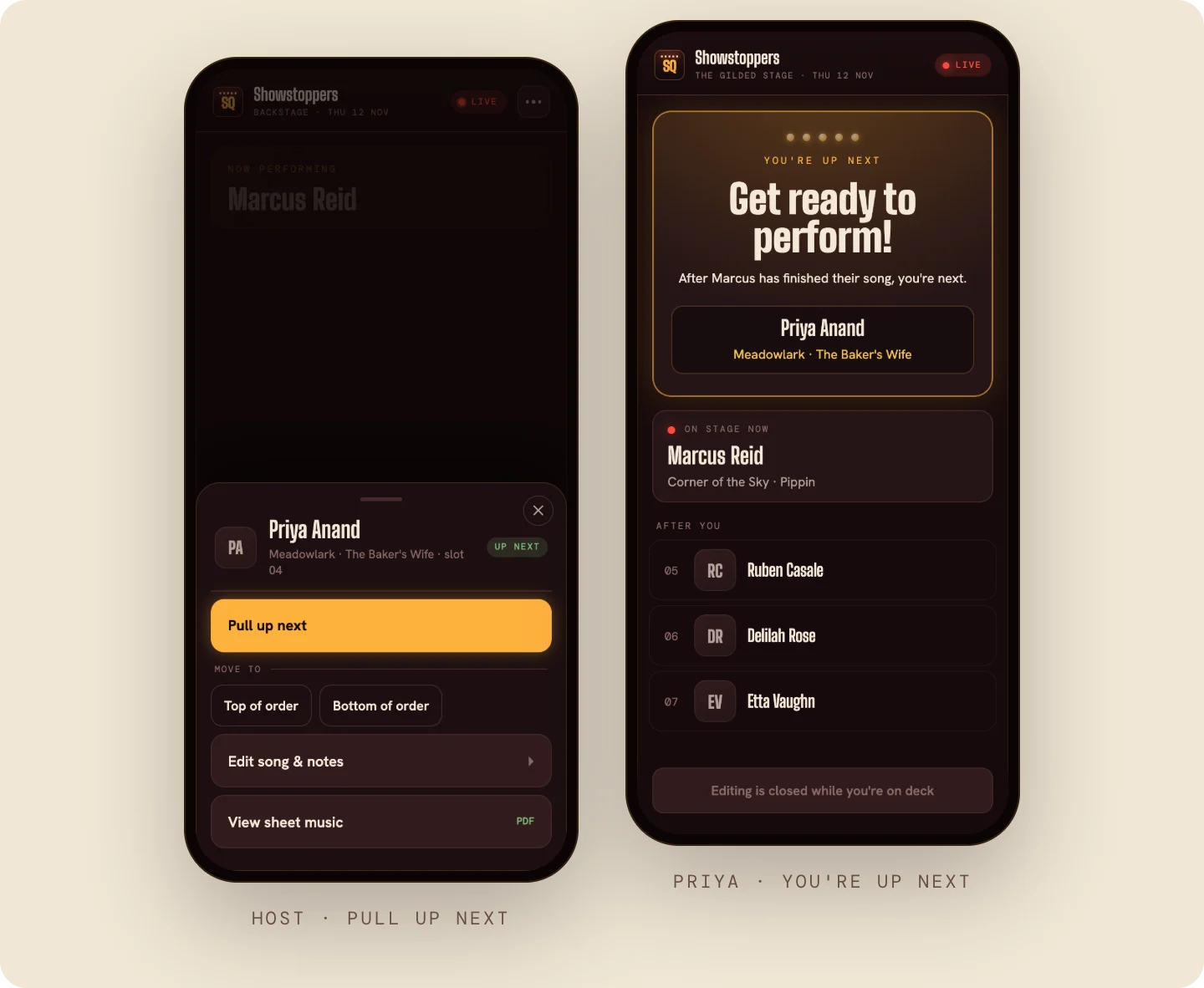
A sign-up that arrives mid-show waits in your review queue until you add or exclude it. If an act has been on longer than the limit you set (I like to set five minutes), the “Now Performing” card flags that it is running long: and it’s the moment to look at what is left in the order and decide what gives. Every change goes straight to Front Row and Big Screen, so the room reads the order you are actually running. When you end the show, the show wrap keeps the order that actually ran, ready for you to review – and potentially move unperformed items into the next show.
So, in conclusion: shape the order before the show, then continue to refine and adapt it during the program. That's what Backstage is perfect for.