You've signed up for your first musical theater open mic or cabaret. Tomorrow a pianist you have never met will sight-read your song in front of a room of several hundred people, with probably thirty seconds' notice. You could argue that the type of musician that puts themselves in that position is somewhat deranged and/or insanely talented. (They’re usually a bit of both!) Regardless, how this performance goes depends less on your voice than on the pages of sheet music you hand them. So this post is all about how to mark up sheet music for an accompanist. It applies equally to musical theatre auditions as well.
“Your music is talking before you sing a single note.”
— Kyle Branzel, audition coach and former audition pianist
First a quick disclaimer. This checklist is the result of my own thirty-plus years experience of playing for auditions, accompanying cabaret, music(ally*) directing shows, teaching musical theatre and audition technique, and – yes – the aforementioned sightreading in front of hundreds of people without breaking (too much of) a sweat while staying attuned to the needs of other performers in the moment. (Yes, it is as exhilarating and sometimes scary as it sounds.)
Every accompanist has slightly different personal preferences and some may disagree with one or two of my recommendations, but the items I list here are largely shared among us. This is the same advice I give to the performers I coach every week, and most of it takes just ten minutes and a pencil.
* Fun fact: Americans call the person that typically conducts the pit orchestra, leads and teaches vocal cast rehearsals, and oversees all of a show’s musical interpretation the “Music Director”. Whereas Brits call them a “Musical Director”.
Bring the key you sing it in
The pianist will play whatever is on the page. If the page is in E flat and you sing it in C, you get E flat. Audition notices often say the accompanist will not transpose; a pianist facing thirty songs in a row will usually not either. (It is also a very rare skill for a pianist to be able to do this while truly sightreading.)
So find out which key you actually sing in, then buy or print the music in that key; most sheet-music sites (like MusicNotes) sell popular songs in several keys. If you transposed it yourself with software, check the result bar by bar. A dropped accidental in bar 12 is the pianist's problem during the show, and then yours during the performance.
If you’ve changed the key from the original published key, that’s usually just fine for cabaret (MDs typically do not accept it in an audition with prescribed audition cuts). If you read music well yourself, scan the sheet music for engraving errors. (And if you don’t, it doesn’t hurt to ask a musician friend that does.) This is much more common than you would think. I follow a wonderful MD on Instagram called Inga Davis-Rutter who frequently publishes some of the craziest examples of poorly engraved music she receives at auditions. If you’re seeing lots of double sharps and flats, or you’ve bought the sheet music in C flat major, expect to be setting yourself up for a bit of a car crash with a sightreading pianist, no matter how good they are.
And one more note on keys: if you’re singing a song from the host's own songbook and it lists a key beside the song, that is the key you will get.
Mark the cut, start and end
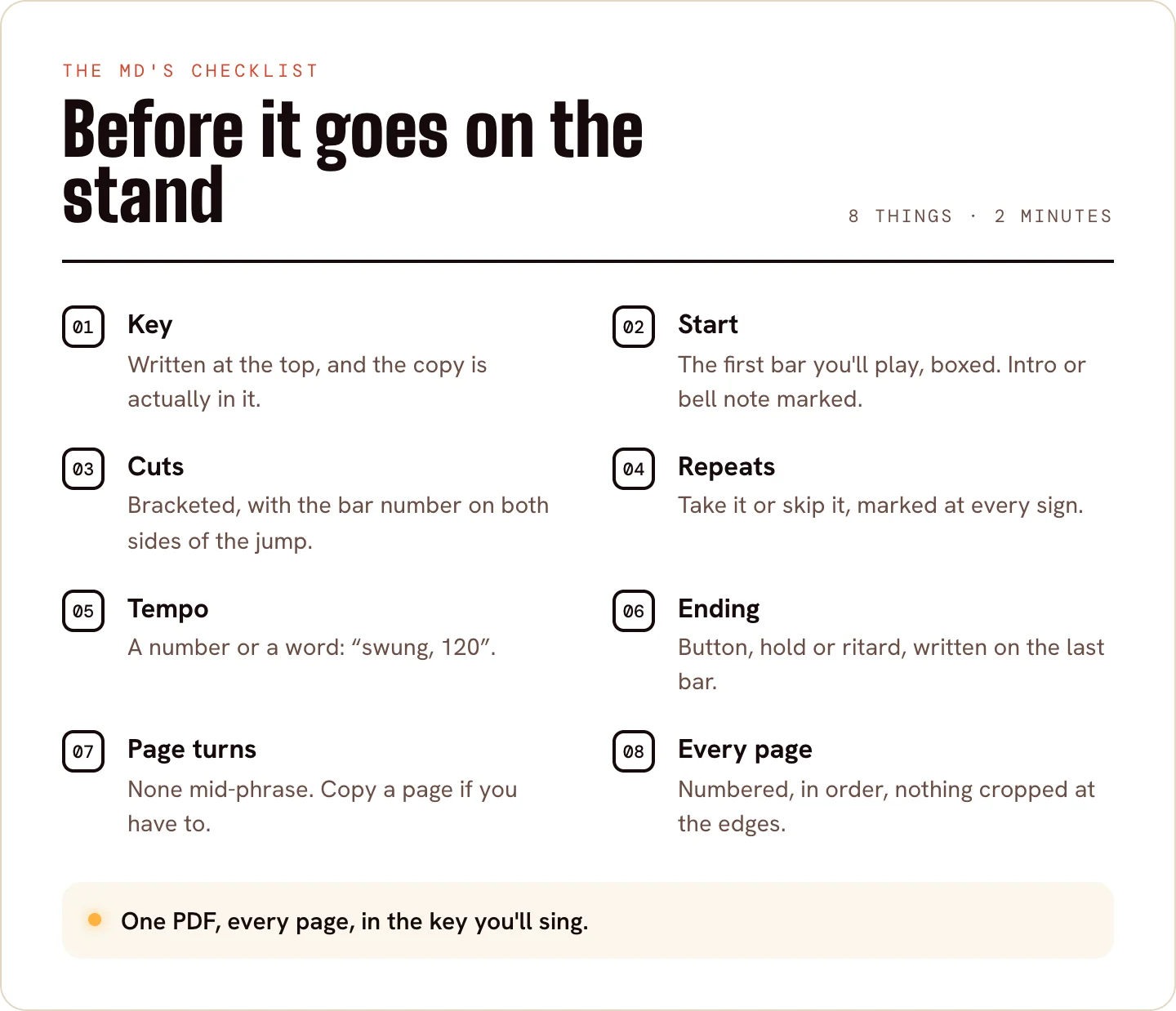
Open mics and cabarets usually want the whole song, or a slightly shortened version if it runs particularly long (3-5 minutes is the sweet spot for a cabaret song). Auditions want a cut: a 16-bar cut runs under a minute, a 32-bar cut under two, and the number specified is more of a duration thing, not an exact count. Whatever the length, if you’re going to make cuts the pianist needs three things on the page:
- Where to start. A bracket and the word START at the first bar they play. For two bars of vamp, bracket them and write "vamp x2". For a bell tone (one note for your pitch), write "bell tone" and circle it.
- Where you come in. An arrow at your first sung note. The pianist's eyes are mostly going to be on the piano part unless you draw your attention up onto the vocal line.
- Where to stop. A double bar and END, or "ride out" if you want the written ending played under you.
Everything you do not want played gets one clean X through it. Never leave two possible endings on one copy: if you sing a 16-bar cut at auditions and the full song at open mics, maintain two copies. If a cut jumps from verse to bridge, check that the join makes musical sense (same key, same tempo, no half-finished sentence) and draw the jump as a big arrow on both pages.
I personally prefer the entire piece (all of the original pages) to be handed to me, even if it’s got cuts. That way I can see the title page, tempo, stylistic indications like swung eighth notes, and unspoken clues about what to expect throughout the piece (for example, just seeing that it’s written by Sondheim or Jason Robert Brown tells me more than you would think). If you’re going to exclude the title page, make sure you clearly mark the first page of your cut score with the name of the song, what show it’s from, tempo markings, key and time signatures, etc.
Repeats, D.S., codas and page turns
Repeats are where sight-readers often get lost – especially if they’re not given enough time to assess the score before beginning to play from it. If you want a printed repeat, there’s no harm in circling the repeat mark; and if you don’t, clearly X the repeat sign and write "no repeat" above. It also doesn’t hurt to circle 1st time bar and 2nd time bar markings. For a dal segno (D.S.) or a coda, draw the jump as a line across the page, and circle the segno symbol. It’s also good to mark helpful wayfinding in succinct words: "2nd time to coda".
Then the pages themselves. The pianist has two hands on the keys and none for your music.
- No loose sheets EVER! Never bring loose sheets of paper to an accompanist. The tiniest gust of wind causes single pages to slide off the music desk and either into the piano or onto the floor.
- Tape pages edge to edge on the longest edge, accordion-style, or use a binder. A two-, three- or even four-page song can easily lie open with no turns if you plan it out well.
- Put turns where the piano part is less complex if at all possible, ideally not just before a key or surprise clef change.
- Copy at about 93 percent if the original is bigger than letter size. You want to make sure bass notes or chord symbols don’t get lost or fall off the edge.
- Skip glossy sheet protectors (what I know as “Nyrex sleeves”) if you’re going to be under bright stage lights.
Tempo and feel, in words
A metronome mark helps; a word or two helps more. Write the feel or groove at the top of the first page in plain language: “slow ballad”, “driving”, “bluesy”, “heavy”, “colla voce”, "rubato until the chorus, then in time”. Mark where the tempo changes and where it stops: circle a fermata you plan to hold, or a caseura if there’s a breath before the last line where you want there to be complete silence.
Many piano/vocal/guitar (PVG) scores are reduced arrangements that have the piano supporting the melody line throughout. Tell your accompanist if you don’t want them to play the melody with you, and a good MD will be able to reduce it on the fly. The most seasoned accompanists will be listening along to you throughout the performance, and gently adding melodic support as they feel you need it.
Take a moment at the piano before you start
Especially if you’ve not rehearsed with the pianist beforehand (standard practice at cabarets), it’s best to take a few moments with them at the piano before your act if possible. This is your opportunity to say hello, establish a rapport, and share everything important that they need to know.
If you’re in a typically rowdy cabaret bar and the audience is quite happily chatting among themselves between acts, you have a minute or two to sing a few quiet bars at the piano before you head to the mic. That one gesture will tell the pianist the tempo and style faster than anything you’ve written down, and it is the opportunity to run through everything you’ve marked out for their benefit. Trust me, they will appreciate you taking the time to make sure you’re both comfortable. It’s all about setting both of you up for success.
Send it ahead, as one PDF
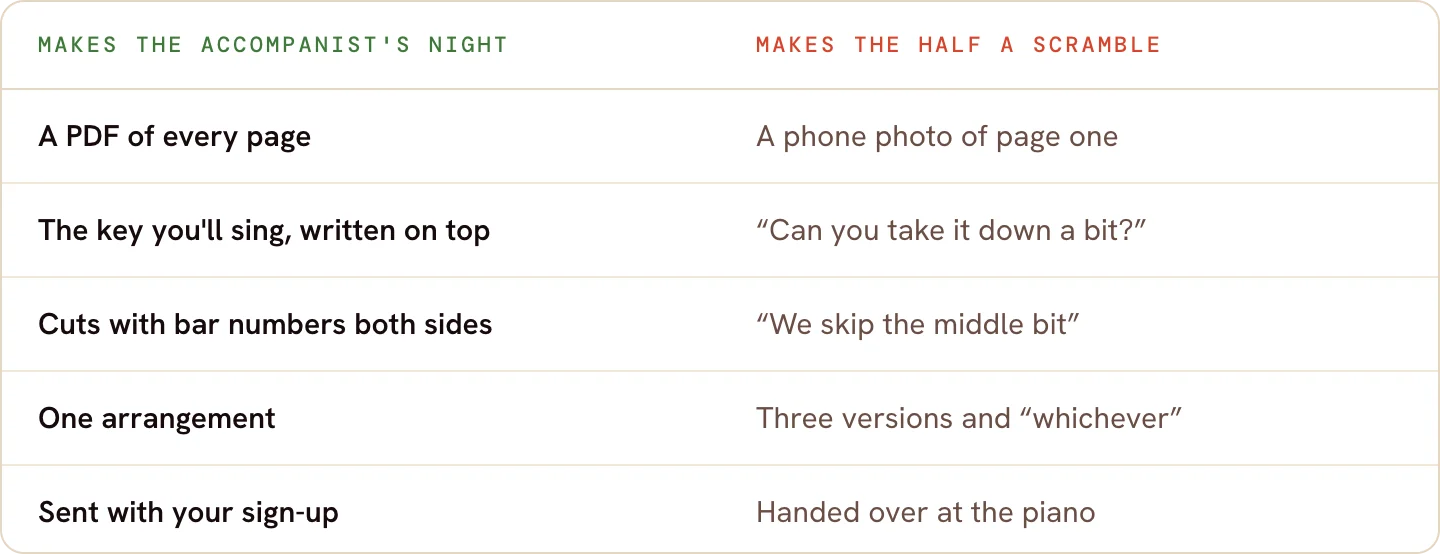
Everything above works better when the pianist sees the score before you walk in. Music that arrives a day or so before gets a good look; pages handed over at the bench get a momentary glance. One long-running musical theater open mic in London asks every singer to email their sheet music in advance, with a second song choice, for this reason.
I cannot stress this enough: If a cabaret pianist or audition accompanist gives you a way to send in music upfront, ALWAYS take advantage of it – especially for more complex or obscure numbers they may not know. They will review it ahead of time, accustom themself to the piece, and very likely practice it before the show – removing the whole sightreading thing from the equation.
Always send it as one file:
- One PDF per song, pages in order, markings already on it. Scan the marked copy rather than describing the cut in a separate email or text message.
- Name the file with the song and your name, not "scan_0417.pdf".
- Keep the PDF limited to the song you’re going to sing. No cover page, no lyric sheet, no three alternative keys.
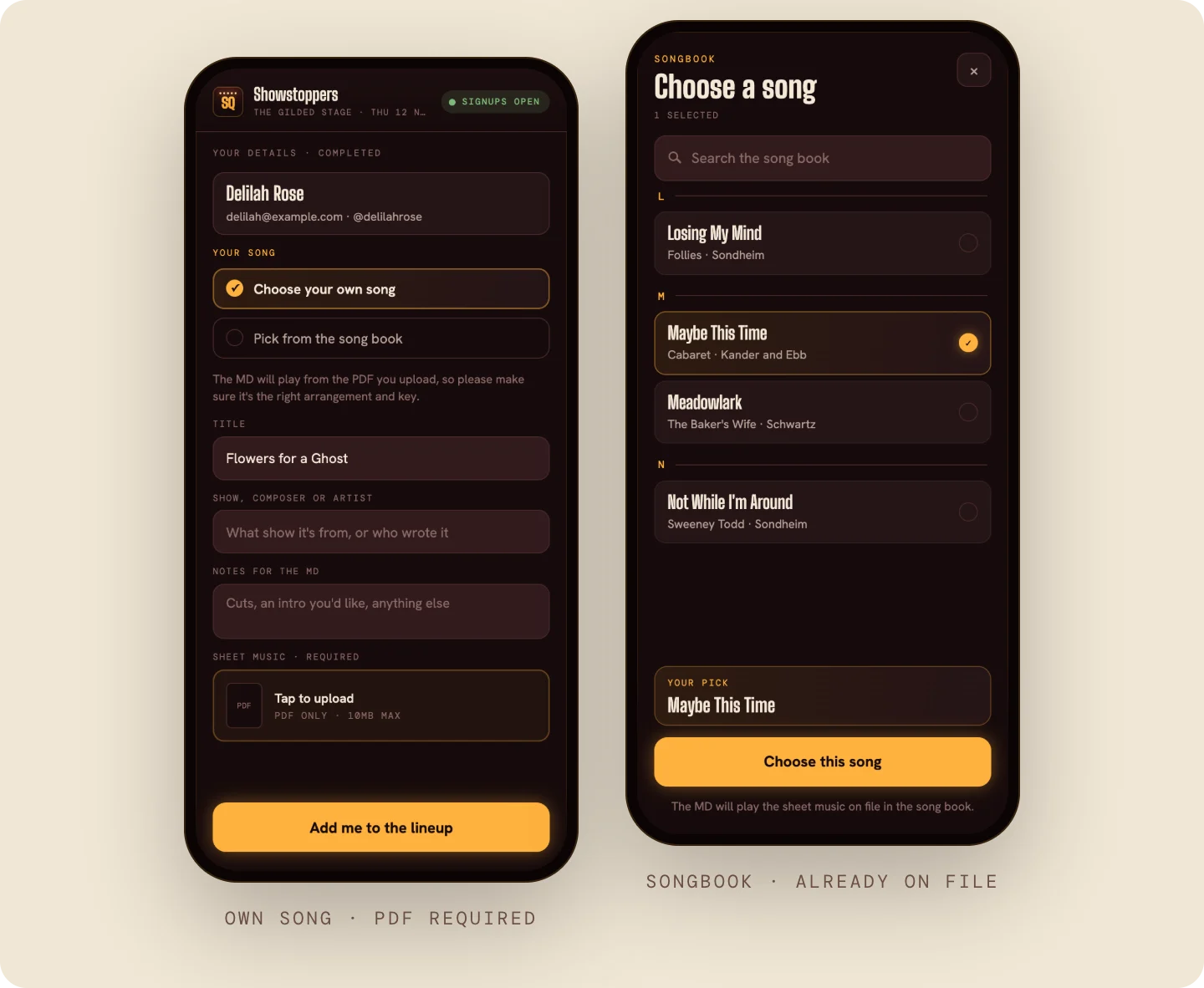
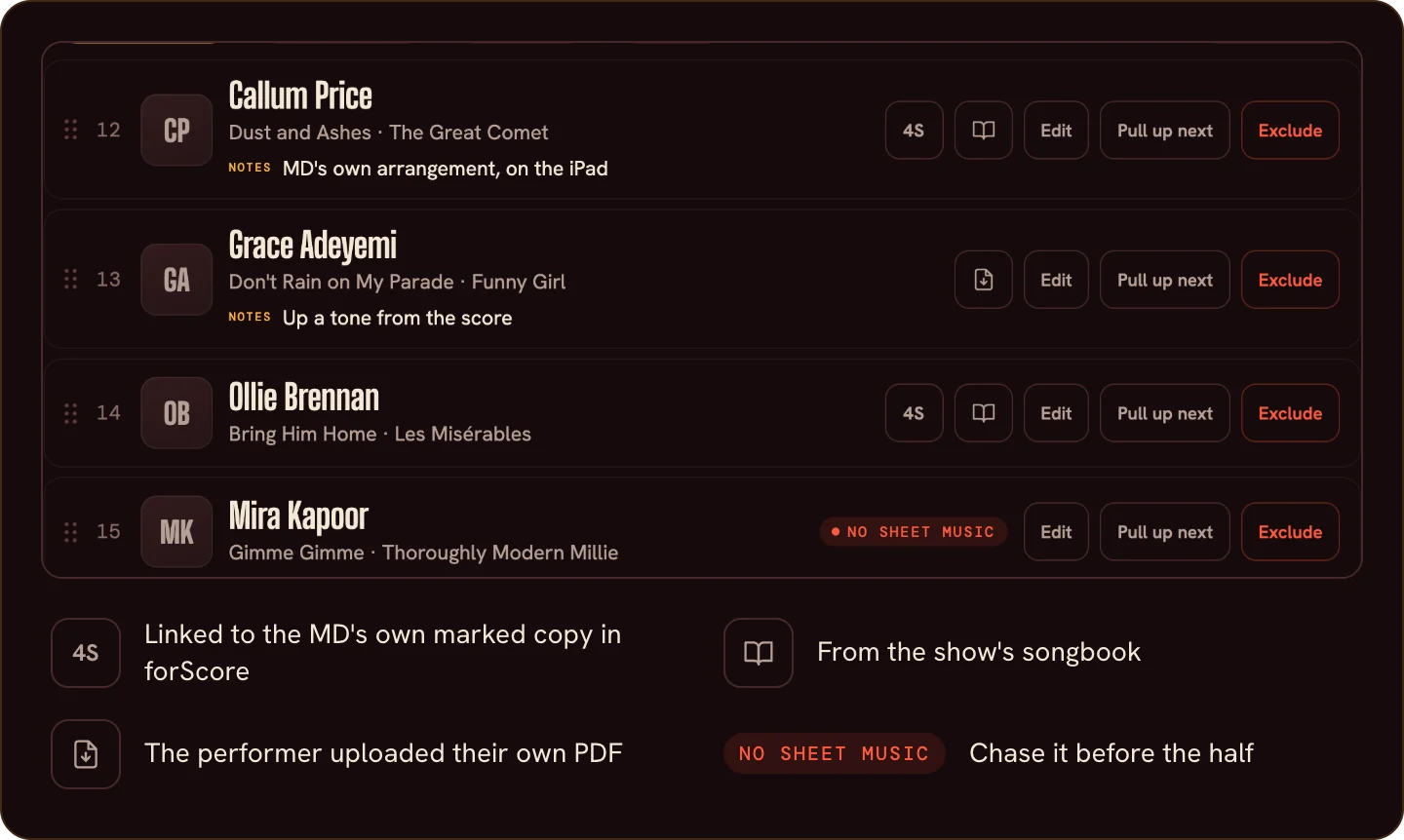
If the show runs on StageQueue: when you sign up, you either pick a song from the host's songbook, where the music is already on file, or choose your own song and upload the PDF right there. The host sees your file against your name in the running order. Your upload is private to the host; it is never shown to the room. If you change your mind, the link in your confirmation email lets you change your song, or swap the file, before you go on. There is no app to download. See how it works.
What to do if you don't have the music
Sometimes the song you want is not sold in your key, or you only know it from a recording. Three honest options, in the order the pianist will thank you for them:
- Pick something you do have. The song you can hand over clean beats the song you can only hum.
- Ask the host, in advance. Many music directors maintain a large library of sheet music and can easily source a standard. Always ask before the show, not at the piano. Some shows on StageQueue let you choose "Please source sheet music" when you sign up, so the host knows to find it, or "Will bring hard copy" so they expect you to bring a paper copy. Both are offered only before the show starts, and only where the host has turned these options on.
- Bring a real piano-vocal score, not a chord chart. A lead sheet gives the pianist an outline. A lyric sheet, or the song on your phone, gives them absolutely nothing to work from – so don’t be surprised if they refuse to put you on the list without adequate sheet music. Expecting them to source and purchase music (at their expense) during a live show is just not reasonable.
A good pianist will get you through almost anything. Preparing sheet music for an accompanist comes down to the key you sing in, a clean cut, clear repeats and other markings, the feel in words and the file sent in at least one day before. Do all of that and they will play as if they have known the song for years.
If the show runs on StageQueue, you upload your music when you sign up, and the accompanist has it before you walk in.